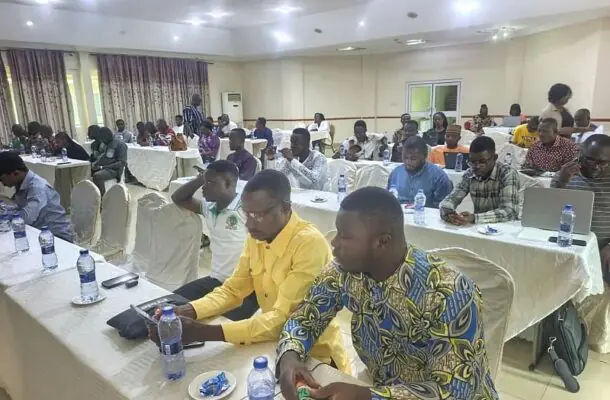
Ghana’s ongoing constitutional reform process has come under discussion at a two-day media engagement in Kumasi, organized by the Citizens’ Platform on Constitutional Reforms (CPCR).
This comes on the back of President Mahama's announcement of a national referendum on the Constitutional Amendments in 2027.
Journalists, were, at the event urged to help citizens understand the proposed changes and participate meaningfully in the process.
The engagement, held at the Royal Lamerta Hotel in Ahodwo, Kumasi, also brought into focus broader governance and development challenges, including illegal mining.
Media practitioners from the Ashanti, Ahafo, Bono, Bono East, Western North and Central regions were brought together at the workshop.
Governance Advisor at the British High Commission, Clara Osei Boateng, urged journalists to use their platforms to educate citizens on the current constitutional review process, so the public can better understand the proposed reforms and contribute meaningfully to the discussion.
She said constitutional reform is a national responsibility and should not be abandoned or restarted each time political power changed hands.
Madam Osei Boateng warned that without a suitable continuity mechanism, the process could lose momentum whenever a new government took office.
She exhorted stakeholders to consider carefully how the reforms could be maintained and advanced in the long-term national interest.
“The debate should go beyond whether Ghana should proceed with constitutional reform”. She added.
It should also examine whether the proposals would resolve the country’s most serious governance problems.
“We should ensure that the Constitution is reformed in a way that addresses most of the fundamental governance challenges we have in this country,” she said.
NEED FOR EXTENSIVE PUBLIC EDUCATION
Madam Osei-Boateng also raised concern that public debate had focused heavily on a small number of prominent proposals, leaving other important recommendations in the Constitutional Review Committee’s report largely overlooked.
She hereby called on journalists to examine the committee’s report, the Government’s Position Paper and the Civil Society Organizations’ Position Paper so they could give the public a balanced account of the issues involved.
According to her, the media has an important responsibility to explain the technical aspects of the constitutional reform in language that ordinary citizens could understand.
Madam Osei-Boateng said the review process was ultimately about citizens'; therefore, they need sufficient information and meaningful opportunities to shape its outcome.
She added that accurate and well-informed media coverage could help build public pressure on political leaders to pursue reforms that reflected citizens’ concerns.
The Citizens’ Platform on Constitutional Reforms is convened by the Centre for Democratic Development (CDD-Ghana), STAR-Ghana Foundation and Democracy Hub. The British High Commission provided funding support for the media engagement.
CURBING THE GALAMSEY MENACE
Meanwhile, Founder of the Right and Responsibility Initiative Ghana (RRIG), Aba Oppong, also spoke on the illegal mining menace, saying government continues to face challenges in dealing with the problem.
She called for stronger community engagement, arguing that people in affected communities need to understand the impact of illegal mining and the role they can play in addressing the problem.
Government has previously outlined measures including law-enforcement operations, reclamation of degraded areas and alternative livelihoods as part of its response to illegal mining.
The two-day engagement therefore provided journalists with an opportunity to examine the constitutional reform proposals while also discussing how the media can contribute to public education and accountability on national issues such as illegal mining.
Story filed by Kwame Wiredu, Kumasi.