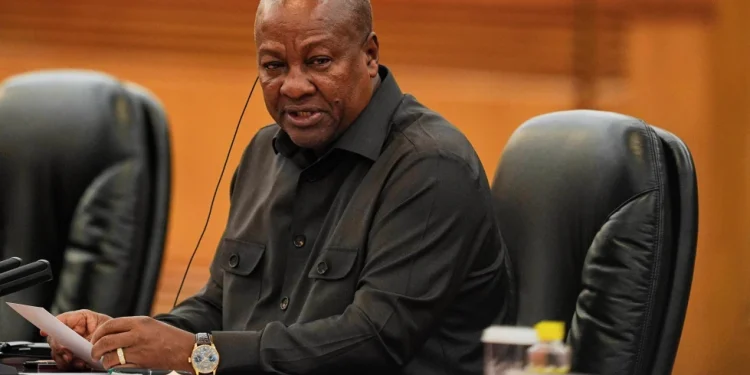
President John Dramani Mahama has explained Ghanaâs decision to reject a proposed health compact from the United States, saying some of the conditions attached to the agreement were unacceptable.
The President said the proposal, which was intended to replace some health funding previously provided through the United States Agency for International Development (USAID), was reviewed by the Ministry of Health before being submitted to Cabinet.
Speaking at the Council on Foreign Relations in New York, he said the Ministry of Health identified several provisions in the agreement that raised concerns over Ghanaâs health data, financing obligations and regulatory authority.
One of the provisions, according to Mr Mahama, required Ghana to provide the United States with its pathogen profile.
âIt states that we shall give the United States our pathogen profile. It also says we should give our medical records. I mean, who takes another country's medical records?â he said.
Mr Mahama said the proposed compact also required Ghana to commit a specified amount of counterpart funding.
He further said the agreement contained provisions under which medicines and other medical products supplied under the programme would not be subject to inspection by Ghanaâs Food and Drugs Authority (FDA).
The President said these conditions contributed to Cabinetâs decision to reject the agreement.
âIt was humiliating,â he said, adding that the compact was rejected âin record timeâ after being considered by Cabinet.
âIâve never seen anything thrown out as fast as that,â he added.
Mr Mahama said the Minister of Health was subsequently directed to inform the US Ambassador of Ghanaâs decision.
He said Ghana would instead pursue measures to strengthen its own health financing and production capacity while continuing to engage international partners.
The rejection comes against the backdrop of the withdrawal of US health and development assistance, which Mr Mahama has previously linked to the launch of the Accra Reset initiative.
The President has said the withdrawal created a significant funding gap for Ghanaâs health sector and exposed the risks of excessive dependence on external health financing.
Mr Mahama has used the Accra Reset to advocate greater health self-reliance, including stronger local production of medicines and vaccines, research capacity and health systems that are less dependent on external funding.
At a separate Accra Reset event in New York, he launched the report A Sovereign Future for Health, which contains recommendations aimed at strengthening health systems in the Global South and reducing dependence on external funding.
The President said the goal was not to isolate Ghana from international partners but to establish relationships based on what he described as more equal and sustainable partnerships.